Credit card interest feels mysterious because the math happens behind the scenes. In practice it follows a simple chain: your APR is turned into a daily rate, that rate is applied to your average daily balance, and the result is added to your statement. If you pay your full statement balance by the due date, you typically pay no interest on purchases at all. This guide walks through each step with worked examples you can check yourself.
The short version
- Your APR is divided by 365 to get a daily rate. For example, 22% APR is about 0.0603% a day.
- Interest is charged on your average daily balance during the billing cycle.
- The grace period makes purchases interest-free if you pay the full statement balance by the due date.
- Cash advances normally have no grace period and start accruing interest right away.
Step 1: Turn the APR into a daily rate
Most issuers calculate interest daily. The daily periodic rate is your APR divided by 365 (some issuers use 360). The table shows what that means for common APRs, and what each one costs on a $2,000 balance over a 30-day cycle.
| APR | Daily rate | Interest on $2,000 for 30 days |
|---|---|---|
| 15% | 0.0411% | $24.66 |
| 20% | 0.0548% | $32.88 |
| 22% | 0.0603% | $36.16 |
| 25% | 0.0685% | $41.10 |
| 30% | 0.0822% | $49.32 |
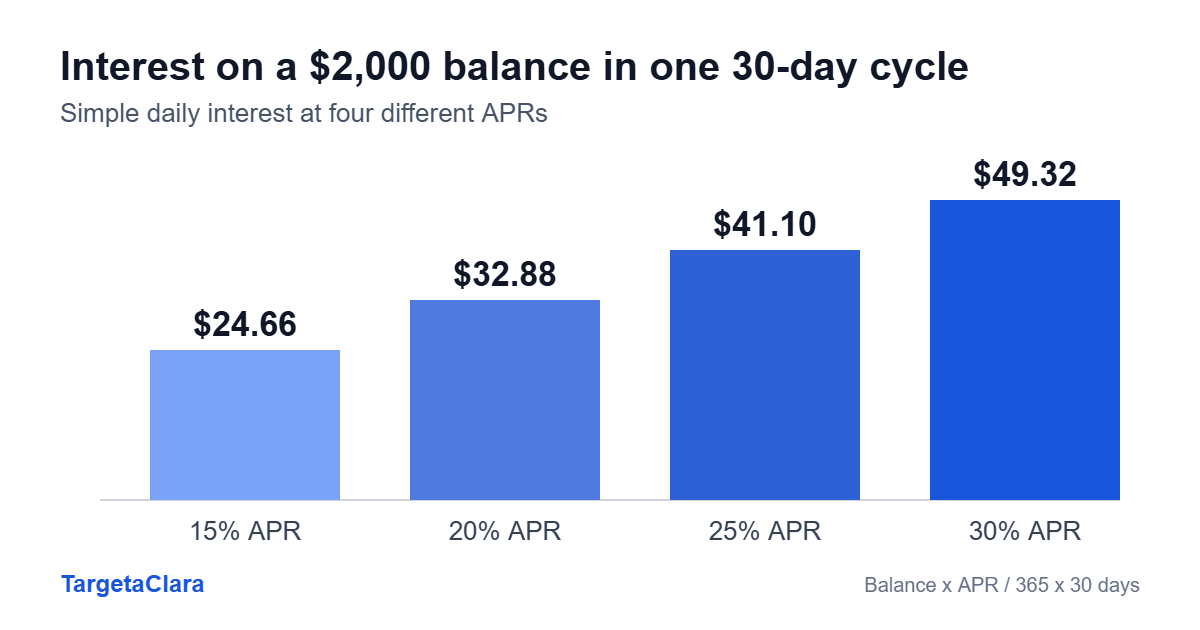
Those figures use simple daily interest. Many issuers also compound, which means each day’s interest is added to the balance before the next day’s interest is calculated. A $2,000 balance at 22% would then cost about $36.48 over 30 days instead of $36.16. The gap is small in a single month but grows when you carry a balance for a long time.
Step 2: Find the average daily balance
Your issuer adds up your balance on every day of the cycle and divides by the number of days. Take a 30-day cycle that starts with a $1,000 balance. On day 11 you make a $500 purchase, and on day 21 you pay $300.
| Days | Balance | Balance x days |
|---|---|---|
| 1 to 10 | $1,000 | $10,000 |
| 11 to 20 | $1,500 | $15,000 |
| 21 to 30 | $1,200 | $12,000 |
| Total | $37,000 |
The average daily balance is $37,000 divided by 30 days, or $1,233.33. At 22% APR, the interest for the cycle is $1,233.33 x 0.0603% x 30 days, about $22.30. Notice that paying earlier in the cycle lowers the average daily balance, so even when you cannot pay in full, paying sooner saves a little.
Why the grace period changes everything
The grace period is the time between the end of your billing cycle and your payment due date. Federal law requires issuers to send your statement at least 21 days before the payment is due, and if you pay the full statement balance by that date you typically owe no interest on that cycle’s purchases.
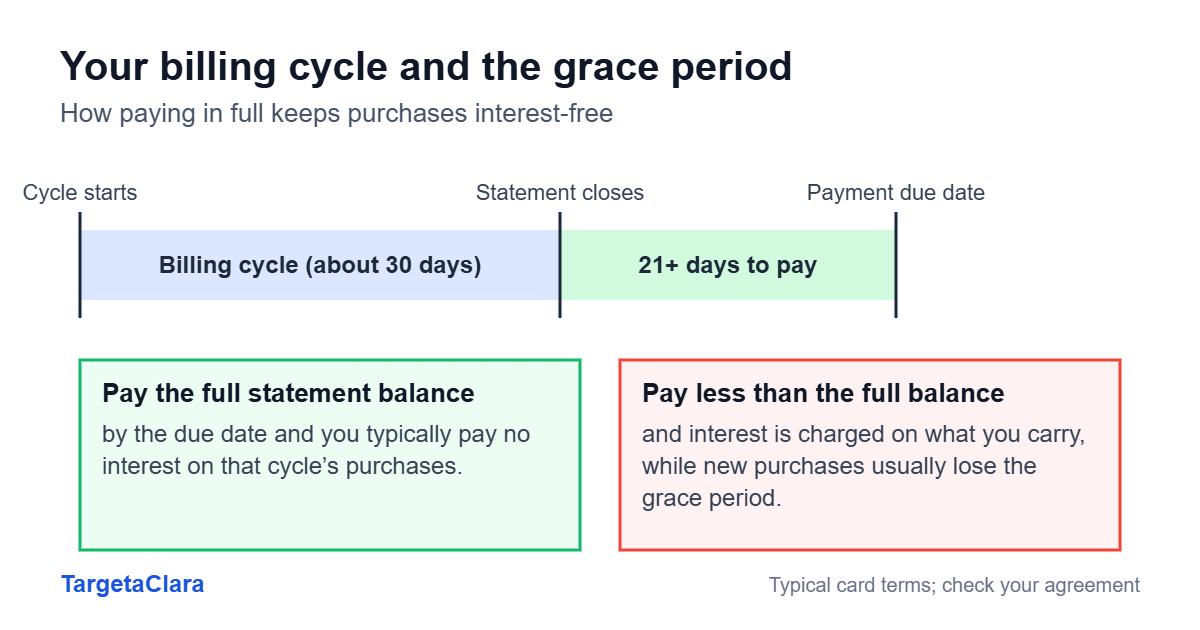
The catch is that the grace period is all or nothing. Suppose your statement balance is $800 and you pay $700. You carry $100 into the next cycle, which costs about $1.81 in interest at 22% APR. You also usually lose the grace period on new purchases, so a $400 purchase made on the first day of the next cycle accrues about $7.23 more. The total is about $9.04, compared with $0 if you had paid the full $800. These figures assume simple daily interest.
APR is not the whole story
A 22% APR applied daily and compounded works out to about 24.6% over a full year if you carry the same balance all year. That is why carrying a balance for a long time costs more than the headline rate suggests. Most cards also have a variable APR, which moves when the Prime Rate moves; our guide on how Federal Reserve decisions affect your APR explains the link.
When there is no grace period
Cash advances usually start accruing interest the day you take them, often at a higher APR than purchases and with an upfront fee. At a 29.99% cash advance APR, a $1,000 advance costs about $24.65 in interest in the first 30 days alone. Our article on cash advances shows the full math. Some cards also apply a higher penalty APR after a late payment, so check your cardholder agreement.
How to pay less interest
- Pay the full statement balance every month to keep the grace period.
- If you cannot, pay as much as you can and pay early in the cycle to lower your average daily balance.
- Pay more than the minimum. The True Cost of Only Paying the Minimum on Your Credit Card shows how slowly a balance shrinks otherwise.
- Compare a 0% balance transfer offer if the fee is lower than the interest you would save: Balance Transfers Explained: How They Work and When They Make Sense.
- Use our credit card payoff calculator to see how long your balance will take to clear and how much each extra payment saves.
Official resources
The Consumer Financial Protection Bureau explains how credit cards work and the common fees, including how to read your statement and where to file a complaint. Your cardholder agreement lists the exact method your issuer uses to calculate interest.
Last updated October 16, 2026. Examples use rounded figures and simple daily interest for illustration; your issuer’s method may differ.
Related reading
- How to Improve Your Credit Score in 90 Days
- Credit Card vs. Debit Card: A Complete Guide to the Differences
- US Credit Card Debt Levels: What the Numbers Really Mean for Households

Jan Llaona is the founder and editor of TargetaClara. He’s currently studying Business at the University of Girona (Spain) and researches and writes the site’s coverage of U.S. consumer credit and personal finance — how APRs and fees actually work, how Federal Reserve decisions filter down to your monthly statement, and how to evaluate credit products on real numbers rather than marketing claims. Every article is checked against primary sources — Federal Reserve data, CFPB guidance, and issuer terms — before publishing.